 sales@dasinfomedia.com


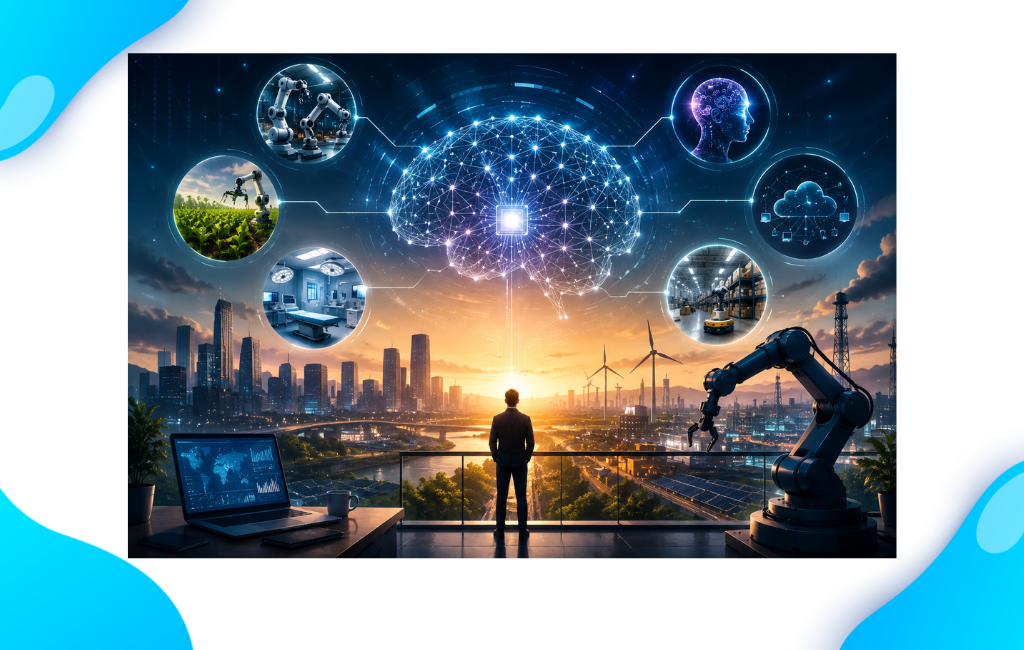
AI Is Just Getting Started
Just a few years ago, Artificial Intelligence meant chatbots and predictive analytics.
Today, businesses use AI to:
 Write Content
Generate code
Automate Workflows
Analyze Documents
Improve Customer Service
But this is only the beginning.
The next decade won’t just make AI smarter-it will make AI part of the physical world.
Instead of simply answering questions, AI will begin operating machines, understanding 3D environments, collaborating with humans, and powering entirely new industries.
For business leaders, the question is no longer “Should we use AI?”
The AI Evolution Timeline
| Era | Focus |
|---|---|
| 2010–2020 | Machine Learning & Data Analytics |
| 2020–2025 | Generative AI (ChatGPT, Claude, Copilot) |
| 2025–2030 | AI Agents & Enterprise Automation |
| 2030+ | Physical AI, Spatial Intelligence, Quantum Networks |
Every wave builds on the previous one.
Generative AI was the first major step.
The next waves will reshape industries.
1. Physical AI: AI That Can Work in the Real World
Today’s AI lives inside a computer. Tomorrow’s AI will work alongside people. This is called Physical AI. Instead of generating text, AI will control robots and intelligent machines that can:
Move safely around People
Understand their Surroundings
Pick up Objects
Inspect equipment
Perform repetitive work
Assist in Healthcare and Manufacturing
Imagine a warehouse where robots unload shipments, sort inventory, and deliver products while humans manage operations. Or hospitals where AI-powered assistants transport equipment and support medical staff. We’re already seeing early examples, and adoption is expected to accelerate over the coming decade.
Industries
Manufacturing
Warehousing
Healthcare
Healthcare
Agriculture
Logistics
2. Spatial Intelligence: AI That Understands Space
Today’s AI understands language. The next generation will understand the world around it. Using cameras, sensors, computer vision, and 3D mapping, AI will build an understanding of physical environments. This is known as Spatial Intelligence. Potential applications include:
🏭 Smart Factories
-
 Real-time production monitoring.
-
Predictive equipment maintenance.
🚗 AI Transportation
-
AI-powered vehicle navigation.
-
Real-time obstacle detection.
🏢 Intelligent Buildings
-
Smart energy optimization.
-
Automated security monitoring.
🚁 Infrastructure Inspections
-
AI-based asset inspections.
-
Faster defect identification.
📦 Warehouse Automation
-
Real-time inventory tracking.
-
Autonomous material handling.
🌾 Precision Agriculture
-
AI-powered crop monitoring.
-
Smart irrigation management.
Instead of simply seeing objects, AI will understand where they are and how they relate to one another.
3. AI Infrastructure Will Become the New Industrial Revolution
Every breakthrough in AI depends on something most people never see – infrastructure. Training and running advanced AI models requires enormous computing power, specialized chips, high-speed networks, and vast amounts of electricity. That’s why companies around the world are investing billions in AI infrastructure.
Instead of traditional data centers, many experts now describe these facilities as AI Factories because they produce intelligence rather than physical goods. Future AI infrastructure will rely on:
Future AI infrastructure will rely on:
High-performance GPU Clusters
Advanced Cooling Systems
Renewable Energy
Faster Networking
Edge Computing
Just as factories powered the Industrial Revolution, AI infrastructure may become the backbone of the AI economy.
4. Looking Beyond Earth: Space-Based Computing & Energy
As AI becomes more powerful, its demand for electricity and computing capacity continues to grow. Some researchers and aerospace companies are already exploring ideas that seemed impossible just a few years ago.
☀️ Space-Based Solar Power
-
Collects uninterrupted solar energy in orbit.
-
Transmits clean power wirelessly to Earth.
-
Supports future AI and global energy needs.
🛰 Orbital Data Centers
-
Space-based facilities for AI computing.
-
Natural cooling improves energy efficiency.
-
Powered by abundant solar energy.
🚀 Reusable Rockets
-
Significantly reduce launch costs.
-
Enable frequent and reliable space missions.
-
Make long-term space infrastructure practical.
While these ideas are still developing, they highlight how AI’s future may depend on innovations beyond Earth.
5. Quantum Networks Could Redefine Secure Communication
Today’s internet moves information using classical signals. Tomorrow’s networks may use the principles of quantum physics. Quantum networks promise:
| 🔐 Ultra-Secure Communication | Signals that are far harder to intercept undetected. |
| ⚡ Faster Scientific Collaboration | Research teams are sharing data at new speeds. |
| 🏦 Stronger Financial Security | Transactions protected by quantum-grade encryption. |
| 🏥 Protected Healthcare Data | Sensitive patient information kept genuinely private. |
Although widespread quantum networking is still years away, governments and technology companies worldwide are investing heavily in quantum communication research.
What This Means for Businesses
You don’t need to build robots or launch satellites. But understanding where technology is heading helps businesses make smarter investments today.
Organizations focusing on:
Digital Transformation
AI-Ready Workflows
Clean, Connected Data
Cloud Infrastructure
Automation
will be better prepared for the next generation of AI. The companies that wait until Physical AI or Quantum Networks become mainstream may find themselves playing catch-up.
Key Takeaways:
Generative AI is only the beginning.
Physical AI will connect intelligence with robots and machines.
AI agents will automate increasingly complex business workflows.
AI infrastructure, space technologies, and quantum networking could power the next era of innovation.
Businesses should focus on becoming AI-ready today rather than waiting for future breakthroughs.
Related Blogs


 +1 813 467 8539
 sales@dasinfomedia.com