 sales@dasinfomedia.com


Ordonova recently shared an interesting story about a UK-based company’s AI journey. The company had invested in Microsoft Copilot, given employees access to AI tools, and expected productivity gains. However, the results were not as expected.
According to Ordonova, the deeper issue was not the AI technology itself, but the operating model around it. The way AI was implemented, managed, and integrated into everyday workflows played a major role in the outcome.
5 Key Enterprise AI Challenges
Problem 1: Most employees don’t know how to write effective prompts.
This wasn’t a technology issue.
It was a communication issue.
Employees knew what they wanted.
They just didn’t know how to translate their thoughts into instructions that AI could understand.
When Copilot didn’t produce the expected result, the immediate conclusion became:
“AI isn’t that useful.”
But AI wasn’t the bottleneck.
The prompt was.
We’re expecting every employee – from HR to Finance to Marketing- to suddenly become an AI prompt engineer.
That’s simply unrealistic.
Technology should adapt to people.
Not the other way around.
Problem 2: Vendor lock-in kills productivity.
Employees quickly discovered that different AI models excel at different tasks.
Some preferred Claude for writing. Others preferred ChatGPT for reasoning. And some relied on Copilot because it integrated with Microsoft 365.
The problem? The company only approved one model. Employees had no flexibility.
Imagine telling a designer they can only use one design tool. Or a developer they can only use one programming language.
Different problems require different tools. AI should be no different.
AI has no understanding of your business.
Problem 3: Shadow AI creates governance nightmares.
Then came the “oops” moment.
One employee wanted better results. So they copied confidential company information into Claude.
From the employee’s perspective, they were simply trying to do their job better.
From the CTO’s perspective …
“Governance had just broken down.”
Sensitive information had left the company’s controlled environment.
This isn’t an isolated incident. It’s happening in organizations around the world.
When employees don’t have the right tools – or don’t know how to use them they find their own way. That’s when compliance, security, and governance become real risks.
Problem 4: AI has no understanding of your business.
Even when employees wrote decent prompts, the output often missed the mark.
The AI didn’t know:
- Your brand voice
- Your products
- Your customers
- Your industry terminology
- Your internal processes
- Your compliance requirements
- Your previous decisions
Every conversation started from zero. Every employee had to provide the same context repeatedly.That isn’t intelligence. That’s repetitive prompting.
Problem 5: Every department is building its own AI island.
Marketing uses one AI tool. Sales uses another. HR has a chatbot. Finance experiments with something else. Operations builds another workflow. Each department optimizes itself. But none of these systems talk to each other.
Meanwhile, the company’s CRM, ERP, HRMS, document management system, knowledge base, and customer support platform remain disconnected from the AI experience.
AI becomes another silo instead of breaking silos.
The Bigger Question
Why are we expecting employees to become AI experts?
Shouldn’t AI understand the business instead?
Shouldn’t it know our policies, our customers, our terminology, our workflows, and our systems?
Shouldn’t employees be able to describe their goal in plain language instead of mastering prompt engineering?
Shouldn’t companies have the freedom to choose the best AI model for each task without compromising governance?
The Missing Layer
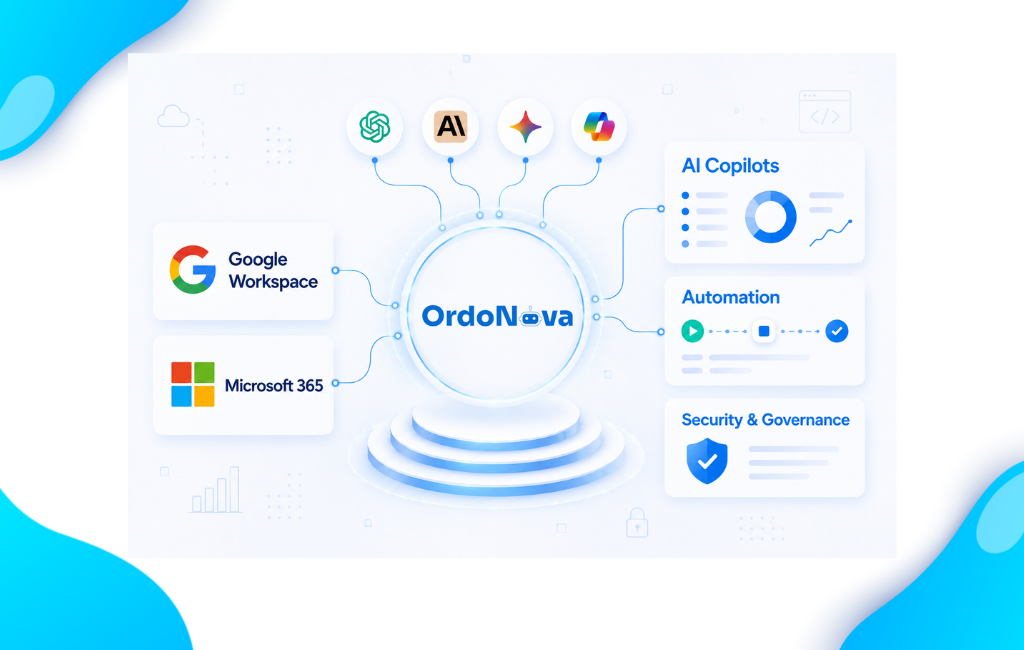
The future isn’t about choosing between ChatGPT, Claude, Gemini, Copilot, or the next model that arrives. The future is having an intelligent orchestration layer that sits above them.
A Layer That:
- Understands your company.
- Connects CRM, ERP, HR, finance, and business systems.
- Applies brand guidelines automatically.
- Enforces governance and security policies.
- Selects the most appropriate AI model for the task.
- Gives employees the outcome they need even if they aren’t expert prompt writers.
Employees shouldn’t have to think about which AI to use. They should simply describe the outcome they’re trying to achieve. The system should take care of the rest.
Where OrdoNova AI Fits In
At OrdoNova AI, this is exactly the challenge they are solving. They believe the future of enterprise AI isn’t another chatbot.
It’s an AI Operating Layer that connects your business systems, understands your organization, enforces governance, orchestrates multiple AI models, and enables every employee not just AI experts to become more productive.
The winners in enterprise AI won’t be the companies with the most AI licenses. They’ll be the ones that make AI accessible, secure, connected, and genuinely useful for everyone. Because AI shouldn’t force people to learn a new language. AI should learn the language of your business.
About the Inspiration
This article is inspired by insights shared by OrdoNova AI on the future of Enterprise AI and AI Operating Models. The content has been rewritten and expanded with additional perspectives for the Dasinfomedia audience.
Related Blogs


 +1 813 467 8539
 sales@dasinfomedia.com