 sales@dasinfomedia.com


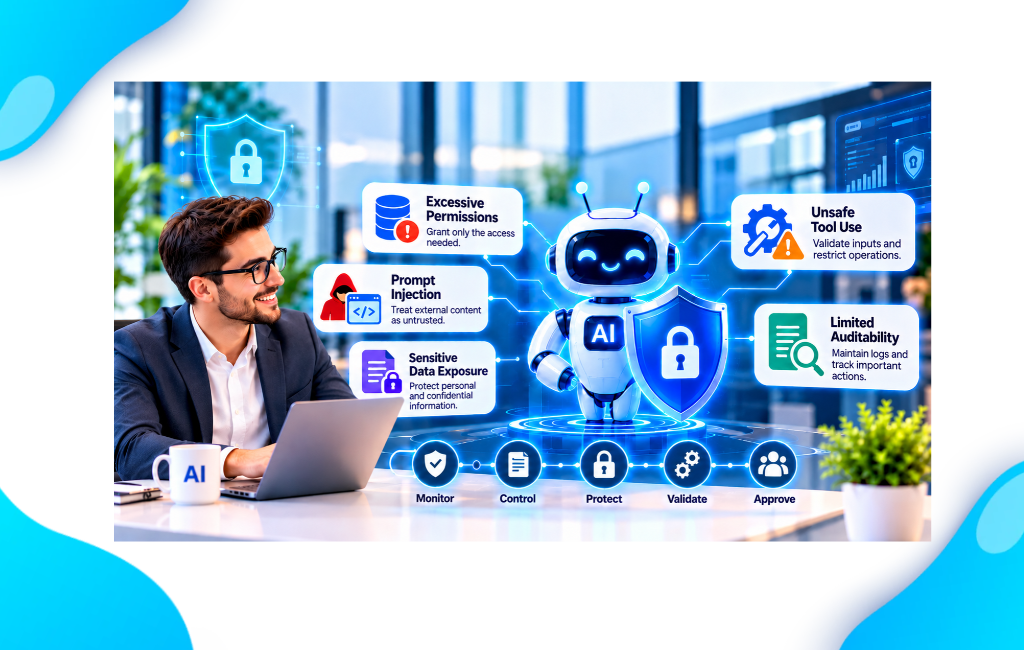
AI agent security involves protecting AI agents, the information they access, the tools they use, and the actions they are authorized to perform.
Unlike a simple question-answering system, an agent may interact with databases, email, customer records, financial systems, and external applications. This creates security considerations beyond the quality of its responses.
The key challenge is ensuring that an agent can perform its intended tasks without receiving unnecessary access or making unauthorized changes
Five Important AI Agent Security Risks
1. Excessive Permissions: An agent may receive access to more data or functionality than its task requires. If its instructions are misunderstood or its behavior is manipulated, excessive access can increase the potential impact.
Use least-privilege permissions and grant only the access required for a defined task.
2. Prompt Injection: Malicious or misleading content in documents, websites, emails, or other inputs may attempt to influence an agent’s behavior
Treat retrieved content as untrusted data, separate instructions from information, and restrict the actions an agent can take.
3. Sensitive Data Exposure: Agents may process personal information, confidential documents, or internal business records.
Organizations should apply appropriate data access rules, retention policies, encryption, and controls on what information is sent to external model providers.
4. Unsafe Tool Use: An agent connected to business tools may attempt an inappropriate action or use a tool in an unexpected way.
Validate tool inputs, restrict available operations, and require explicit approval for high-impact actions.
5. Limited Auditability: If a business cannot determine which agent accessed information or initiated an action, investigating incidents becomes more difficult.
Maintain appropriate logs of agent identity, tool usage, approvals, and important actions
How Can Businesses Secure Multi-Agent Systems?
Security must apply to the entire workflow, not just each agent individually.
A secure architecture should establish agent identities, enforce access permissions, validate data exchanged between agents, protect credentials, and monitor suspicious activity.
Agents should not automatically inherit the permissions of other agents. Each component should have only the authority it needs.
Organizations should also test how agents respond to malicious inputs, unexpected requests, unavailable tools, and attempts to bypass their instructions.
Where Should Human Approval Be Required?
Not every action requires manual approval. Low-risk activities, such as categorizing a request, may be automated with appropriate testing.
Actions that could affect finances, customer rights, sensitive records, security settings, or legal obligations may require stronger controls and human authorization.
The level of oversight should reflect the potential impact of a mistake.
Security Is an Ongoing Process
AI agent security is not a one-time configuration. Permissions, integrations, models, and business requirements change over time.
Regular reviews, testing, monitoring, and incident response help organizations maintain appropriate safeguards as their agentic systems evolve.
Related reading: What Is AgentOps?What Is AgentOps? Managing AI Agents After Deployment.
Related Blogs


 +1 813 467 8539
 sales@dasinfomedia.com
