 sales@dasinfomedia.com


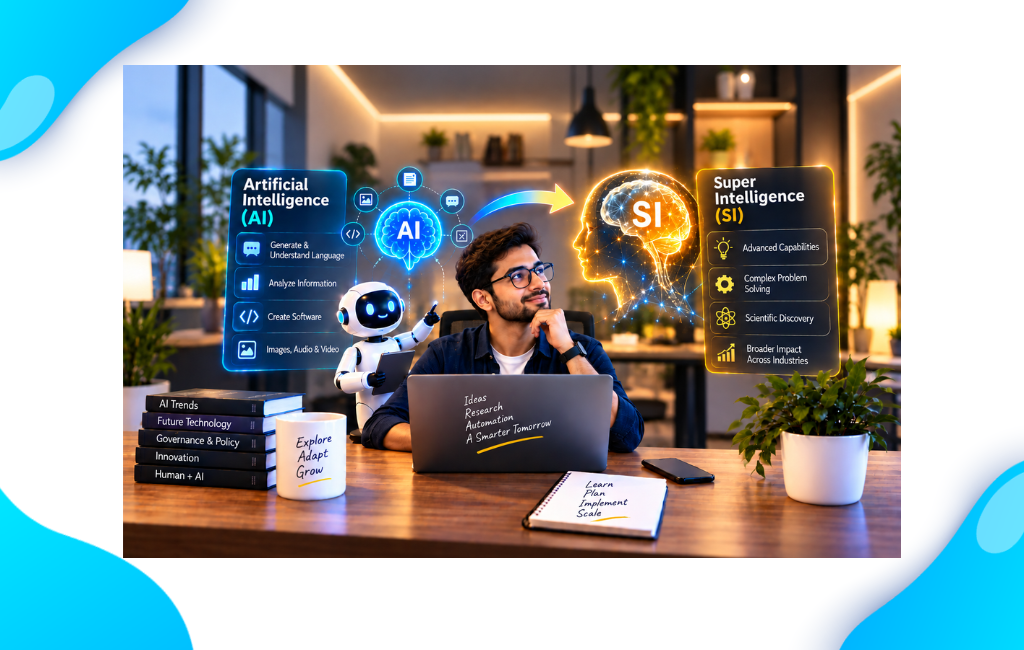
The change reflects a broader discussion about how rapidly AI capabilities are evolving. Modern AI systems can generate content, analyze complex information, automate workflows, write software, interact with users, and support decision-making across industries.
But there is an important distinction:
The technology has not suddenly changed from AI to a completely different technology. The terminology and the way advanced AI capabilities are described are changing.
What Is Super Intelligence?
The term Super Intelligence generally describes intelligence that could exceed human capabilities across a broad range of cognitive tasks.
In traditional AI terminology, this concept is often associated with artificial superintelligence (ASI) a hypothetical or future form of intelligence that could outperform humans in areas such as reasoning, scientific discovery, planning, creativity, and problem-solving.
However, the current U.S. federal terminology uses “Super Intelligence” (SI) more broadly. The September 29, 2026 executive order defines SI, for federal implementation purposes, as the technologies and systems covered by the existing statutory definition of artificial intelligence.
This means the government terminology should not automatically be interpreted as meaning that fully human-surpassing superintelligence already exists.
Why Is AI Being Called SI?
The reasoning behind the terminology is that today’s most advanced systems are capable of considerably more than earlier forms of software automation.
Modern AI can:
 Generate and understand natural language
Analyze large amounts of information
Create software and technical content
Generate images, audio, and video
Assist with research and knowledge work
Interact with applications and digital systems
Support complex workflows
Assist with scientific and technical tasks
SI vs. AI: What’s the Difference?
| AI | Super Intelligence (SI) |
|---|---|
| Established term for artificial intelligence technologies | Newer terminology used in a U.S. federal context |
| Covers a broad range of intelligent systems | Intended to emphasize increasingly advanced capabilities |
| Used globally across technology and research | Primarily associated with the new federal terminology |
| Includes today’s generative AI and automation systems | Can also refer to the broader frontier of advanced intelligent technologies |
| Established scientific and industry terminology | Still developing as a policy and terminology framework |
One important point is that “superintelligence” already has a specific meaning in AI research: intelligence that substantially exceeds human cognitive abilities. The broader federal use of “Super Intelligence” should therefore be understood in its specific policy context rather than automatically equated with hypothetical artificial superintelligence.
What Does SI Mean for Businesses?
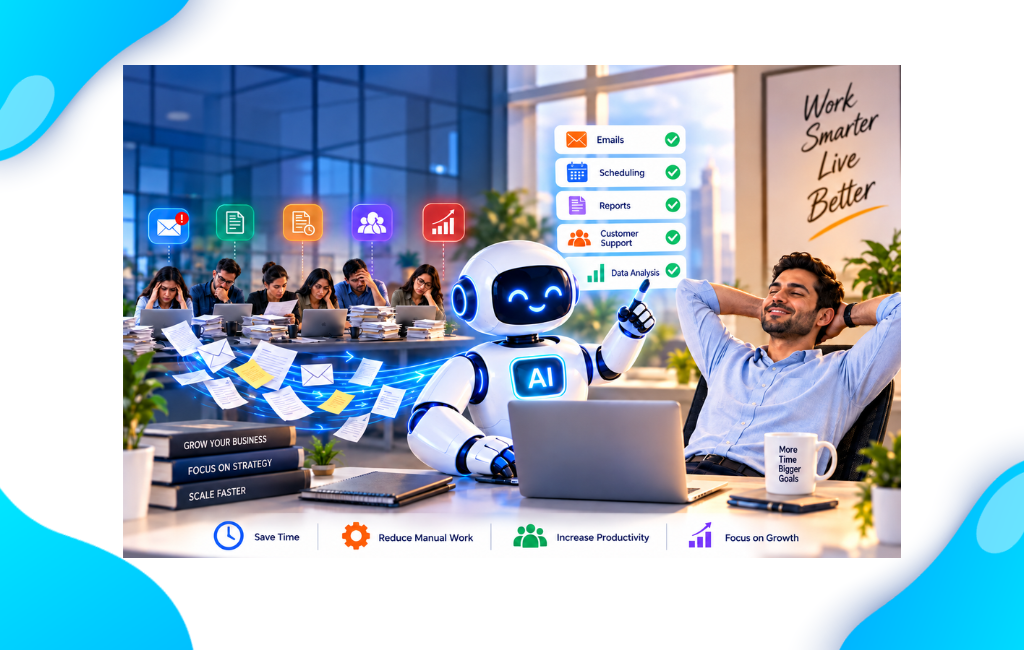
For businesses, the terminology is less important than the capabilities behind it. The practical shift is toward systems that can do more than generate answers. Businesses are increasingly using intelligent technologies to :
Automate repetitive workflows
Analyze business information
Process documents
Connect business applications
Assist employees
Generate reports
Operate AI agents
Support decision-making
Coordinate multi-step business processes
This creates a transition from AI as a tool to AI as part of business operations.
What Is the Future of Intelligent Automation?
The evolution can be viewed as a progression:
Traditional Software: People perform the process using software
Workflow Software: Software performs predefined steps automatically.
Workflow Software: Software performs predefined steps automatically.
AI Automation: AI helps understand information and make context-based decisions within workflows.
AI Agents: AI systems can perform multi-step tasks using tools and business systems.
AI Agents: Future systems may perform increasingly complex reasoning, planning, research, and problem-solving beyond today’s capabilities.
The pace and direction of this progression remain areas of active research and development.
What Businesses Should Focus On
Regardless of whether the technology is called AI, SI, intelligent automation, or another term, organizations should focus on practical capabilities and measurable outcomes.
Key questions include:
- What business processes consume the most manual effort?
- Which workflows involve repetitive data entry?
- Where are employees switching between multiple systems?
- Which decisions can be supported by intelligent software?
- Where can automation reduce processing time?
- Which existing systems should be connected?
- How can AI improve customer and employee experiences?
The objective is not simply to adopt new terminology.
The objective is to make business operations more intelligent, connected, and efficient.
Super Intelligence (SI) is emerging as a new term in U.S. federal communications for technologies covered by the existing definition of artificial intelligence. It reflects the rapid evolution of intelligent technologies and their expanding capabilities.
For the broader technology industry and global business community, AI remains the established term.
The more important shift is happening underneath the terminology: intelligent systems are moving from isolated tools toward AI-powered automation, agents, connected workflows, and intelligent business operations.
The future of intelligent technology may ultimately be defined less by what we call it—and more by what these systems are capable of doing.
Related Blogs


 +1 813 467 8539
 sales@dasinfomedia.com