 sales@dasinfomedia.com


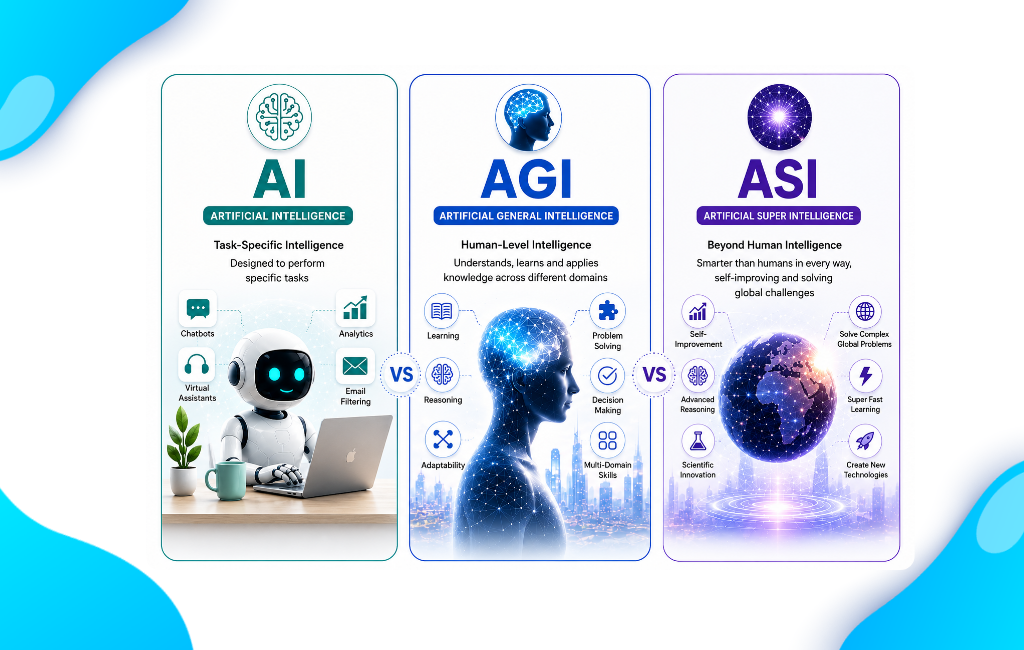
Artificial Intelligence is already woven into daily life – chatbots, navigation apps, recommendation engines – but the conversation is shifting toward what comes next. AGI and ASI describe stages of intelligence far beyond what exists today. Understanding the difference matters for anyone trying to separate real capability from hype.
Artificial Intelligence (AI)
AI is technology that performs tasks normally requiring human intelligence, such as analyzing data, recognizing patterns, understanding language, answering questions and automating repetitive work. Today’s systems are Narrow AI: excellent within a defined lane, unable to operate outside it.
Examples of AI in everyday life:
💬 Conversational Assistants
-
 ChatGPT, Gemini and Microsoft Copilot handle writing, research and coding tasks
-
Siri and Alexa respond to voice commands and manage daily tasks
🧭 AI Recommendations
-
Netflix recommendations learn viewing habits to suggest new content
-
Google Maps navigation predicts traffic and finds the fastest route
🎧 Customer Support
-
AI chatbots answer common customer questions 24/7, providing fast and reliable support
-
Escalates complex issues to human agents when needed
How Businesses use it Today:
 Automate Customer Support
Generate Marketing Content
Analyze Business Data
Improve Sales Processes
Real-Time Fraud Detection
Schedule Appointments
Personalize Experiences
Streamline Operations
Artificial General Intelligence (AGI)
AGI would think, learn, and solve problems the way a person does – not trained for one task, but able to understand new situations and move across domains without retraining.
Key features of AGI
🧠 Human-Like Reasoning
-
Thinks through problems the way a person would
-
Makes decisions grounded in real understanding
📚 Continuous Learning
-
Learns from experience, not just training data
-
Understands and learns across multiple subjects
🧩 Adaptive Problem-Solving
-
Solves problems it has never seen before
-
Adapts to new environments with no retraining
Example: Imagine one AI assistant that can, without needing separate training for each task
Write Software
Teach Students
Diagnose Medical Conditions
Create Business Strategies
Design Websites
Manage Financial Reports
Artificial Super Intelligence (ASI)
ASI describes intelligence that surpasses humans in every domain at once — not just matching human ability, but solving problems humans currently cannot, improving itself continuously, and learning at a pace no person could follow.
Key features of ASI:
🚀 Beyond Human Ability
-
Smarter than humans in every field
-
Applies advanced reasoning to any problem
🔄 Self-Improving Intelligence
-
Improves its own capabilities over time
-
Learns at a pace no person could match
🔬 Scientific Breakthroughs
-
Solves complex problems humans cannot
-
Drives discoveries beyond current science
Example: An ASI system could.
Discover cures for complex diseases
Solve climate change challenges
Design advanced clean energy systems
Build revolutionary technologies
Predict natural disasters
Build revolutionary technologies
Optimize global transportation
Accelerate scientific discoveries
Quick comparison
| Feature | AI | AGI | ASI |
|---|---|---|---|
| Full form | Artificial Intelligence | Artificial General Intelligence | Artificial Super Intelligence |
| Exists today | Yes | No | No |
| Intelligence level | Task-specific | Human-level | Beyond human |
| Learning ability | Limited | Learns like humans | Self-improves continuously |
| Adaptability | Low | High | Extremely high |
| Examples | ChatGPT, Siri, Alexa | Not available yet | Theoretical |
| Business use | Widely used today | Future | Future |
Frequently Asked Questions (FAQs)
Related Blogs

 +1 813 467 8539
 sales@dasinfomedia.com