 sales@dasinfomedia.com


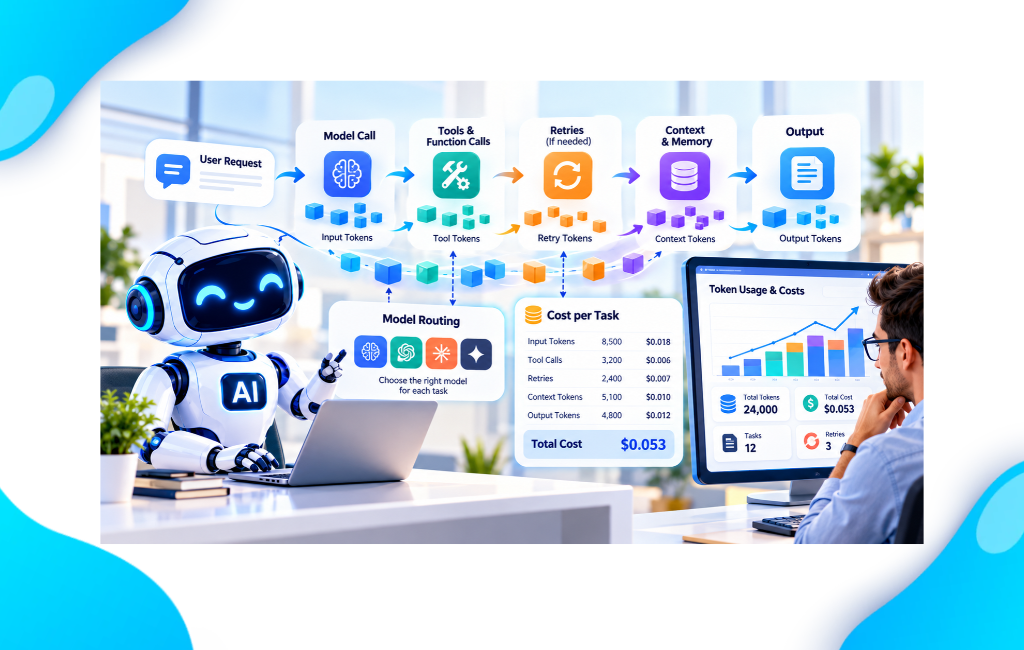
Token economics describes the relationship between token consumption, model pricing, system architecture, and the value generated by AI applications.
AI models often process text and other supported inputs in units called tokens. Depending on the provider and model, usage charges may differ for input tokens, output tokens, cached input, and other capabilities.
For AI agents, understanding token consumption is important because a single business task may trigger several model calls rather than just one.
Why Can AI Agents Cost More Than Expected?
A conventional chatbot may answer a question with one model request. An agent might interpret the task, plan the next action, call a tool, review the result, retry a failed step, and generate a final response.
Each additional model interaction can add cost.
Multi-agent workflows can multiply this effect when one agent delegates work to several other agents.
Costs also depend on context size, model selection, external tool charges, execution frequency, and the complexity of each task.
The Metrics Businesses Should Track
- Cost per Task: Estimate the total cost of completing a defined workflow, including relevant model and tool usage.
- Cost per Successful Outcome: Measure how much it costs to complete a task that meets its quality requirements, rather than counting every execution equally.
- Tokens per Workflow: Compare token consumption across different task types, agents, and model configurations.
- Retry and Failure Costs: Identify usage generated by failed API calls, repeated reasoning, and unproductive loops.
- Cost by Business Function: Separate spending across departments or workflows to identify where AI creates value and where it consumes resources unnecessarily.
Four Ways to Improve Token Efficiency
- Route tasks to suitable models. Simple classification tasks may not require the same model as complex analysis. Model routing can balance cost and performance.
- Manage context carefully. Avoid repeatedly sending irrelevant conversation history or large documents when only a small portion is required.
- Use caching appropriately. Reuse eligible stable inputs or results when doing so preserves correctness and data freshness.
- Control execution loops. Set reasonable limits for retries, tool calls, task duration, and total usage
These techniques should be tested against quality requirements. Lower token usage is not an improvement if it causes more errors or requires expensive human rework.
Token Economics Is More Than a Pricing Problem
Choosing a cheaper model can help, but inefficient architecture may still produce excessive usage. Similarly, a higher-cost model may be justified when it significantly improves task success or reduces downstream work.
Businesses should evaluate total cost alongside quality, reliability, latency, and the value of the completed task.
Related reading: What Is AgentOps?What Is AgentOps? Managing AI Agents After Deployment.
Related Blogs



 +1 813 467 8539
 sales@dasinfomedia.com
